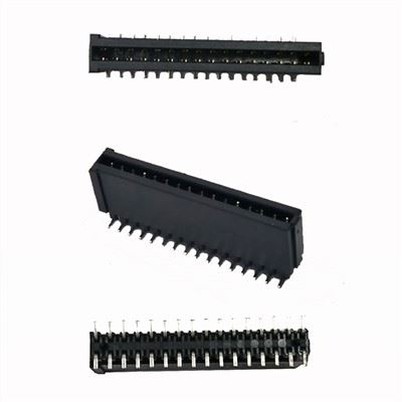

Basic performance of board-to-board connectors
Leave a message
Basic performance of board-to-board connectors
The basic performance of board-to-board connectors can be divided into three categories: mechanical performance, electrical performance and environmental performance.
1 Mechanical performance As far as the connection function is concerned, the insertion and extraction force is an important mechanical performance. Insertion and extraction force is divided into insertion force and extraction force (extraction force is also called separation force), the requirements of the two are different. There are provisions for greater insertion force and minimum separation force in the relevant standards, which shows that from the point of view of use, the insertion force should be small (there are structures with low insertion force LIF and no insertion force ZIF), and if the separation force is too small , It will affect the reliability of the contact.
Another important mechanical property is the mechanical life of the board-to-board connector. Mechanical life is actually a durability index, which is called mechanical operation in the national standard GB5095. It takes one insertion and one unplugging as a cycle, and whether the connector can normally complete its connection function (such as contact resistance value) after the specified plug-in cycle is used as the judgement basis.
The insertion and extraction force and mechanical life of the board-to-board connector are related to the contact structure (positive pressure), the coating quality of the contact part (the sliding friction coefficient) and the dimensional accuracy of the contact arrangement (alignment).
2. Electrical properties mainly include contact resistance, insulation resistance, current and dielectric strength
Contact resistance: High-quality electrical connectors should have low and stable contact resistance. The contact resistance of the connector ranges from a few milliohms to tens of milliohms.
Insulation resistance: a measure of the insulation performance between electrical connector contacts and between the contacts and the shell, and its magnitude ranges from hundreds of megohms to several thousand megohms.
Dielectric strength or withstand voltage: characterizes the ability to withstand the rated test voltage between the contact pieces of the connector or between the contact piece and the shell, which depends on the gap between the circuits (that is, the distance between the contacts and the creepage distance) and the position in the connector. Insulation material used