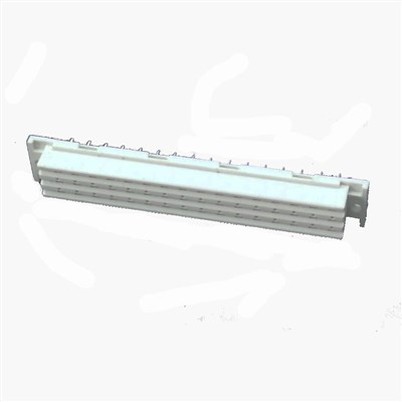

What Is The Connector
Leave a message
Connectors, as key components for current or signal connections, are also an important part of the industrial system. As large as airplanes and rockets, as small as mobile phones and TVs, connectors appear in a variety of different forms, building bridges between circuits or other components, taking on the role of electric current or signal connections.
The connector is CONNECTOR. Also known as connectors, plugs and sockets in China. Generally refers to electrical connectors. That is, a device that connects two active devices to transmit current or signal.
The connector is a component that our electronic engineering and technical personnel often contact. Its function is very simple: to build a bridge of communication between blocked or isolated circuits in the circuit, so that the current can flow, and the circuit can realize the predetermined function. Connectors are an indispensable part of electronic equipment. Observing along the path of current flow, you will always find one or more connectors.
Connector forms and structures are ever-changing. There are various types of connectors with different application objects, frequencies, power, and application environments. For example, the connectors for lighting on the court and the connectors for hard drives, and the connectors for igniting rockets are quite different. But no matter what kind of connector, it is necessary to ensure that the current flows smoothly, continuously and reliably. In general terms, what the connector is connected to is not limited to current. In today's rapid development of optoelectronic technology, the carrier of the signal transmission is light in the optical fiber system. Glass and plastic replace the wires in the ordinary circuit, but the optical signal Connectors are also used in the pathways, and their functions are the same as circuit connectors.
The birth of the connector is conceived from the manufacturing technology of fighter aircraft. The aircraft in the battle must be refueled and repaired on the ground, and the time spent on the ground is an important factor in the victory or defeat of a battle. Therefore, during World War II, the US military authorities were determined to reduce ground maintenance time and increase combat time due to fighter jets.
They first united various control instruments and parts, and then connected them into a whole system by connectors. When repairing, disassemble the malfunctioning unit and replace it with a new one, and the aircraft will be able to fly into the air immediately. After the war, AT-T Bell Labs successfully developed the Bell telephone system, and then the rise of the computer, communications and other industries gave more opportunities for the development of connectors derived from stand-alone technology, and the market expanded rapidly.
Connector classification
As the structure of the connector is becoming increasingly diversified, new structures and application fields are constantly appearing, and trying to solve the classification and naming problems with a fixed model has become difficult to adapt.
1. According to the nature of use
External connector (for external enclosure), internal connector (for internal enclosure).
2. According to the level of the connector
●Level 1. Component to package interconnection (DEVICE TO PACKING):
Refers to the connection of IC CHIP and pin.
●Level 2. The interconnection between the package and the substrate (COMPONENT LEAD TO CIRCCUITRY):
Refers to the connection between COMPONENT and PC board.
●Level 3. Board to Board connection (Board To Board):
Refers to the interconnection between the PC board and the PC board.
●Level 4. Subsystem to Subsystem Connection (SUBASSEMBLY TO SUBASSEMBLY)
●Level 5. The connection between subsystems to I/O (SUBASSEMBLY TO I/O PORT).
●Level 6. System to system connection (SYSTEM TO SYSTEM).
3. According to the processing method
Crimp Type and I.D.CType are also called piercing type, solder type, and zero insertion type (Z.I.F Type).
4. According to the method of use
Wire-to-board connectors, board-to-board connector wires, wire-to-wire connectors, sockets, input and output connectors.
5. According to the form
PCB board connector, flat cable connector, coaxial cable connector, embedded connector, pinch connector, round connector, angle connector, connector for printed wiring board.
6. According to the structure
General connectors, moisture-resistant and waterproof connectors, environment-resistant connectors, air-tight connectors, fire-resistant connectors, and water-resistant connectors.
7. According to working frequency
Low frequency and high frequency (with 3MHz as the boundary).
8. From its versatility and related technical standards, connectors can be divided into the following categories (categories):
①Low-frequency circular connector;
②Rectangular connector;
③Printed circuit connector;
④RF connector;
⑤Optical fiber connector.
Basic performance of the connector
Connector knowledge The basic performance of connectors can be divided into three categories: namely
Mechanical performance, electrical performance and environmental performance.
1. Mechanical behavior
As far as the connection function is concerned, the insertion force is an important mechanical property. Insertion and extraction force is divided into insertion force and extraction force (extraction force is also called separation force), the requirements of the two are different. In the relevant standards, there are provisions for Z large insertion force and Z small separation force, which shows that from the perspective of use, the insertion force should be small (there are low insertion force LIF and non-insertion force ZIF structure), and if the separation force is too large Small, it will affect the reliability of the contact. The insertion and extraction force and mechanical life of the connector are related to the contact structure (positive pressure), the coating quality (sliding friction coefficient) of the contact part, and the dimensional accuracy of the contact arrangement (alignment).
2. Electrical performance
The main electrical properties of the connector include contact resistance, insulation resistance and dielectric strength.
① Electrical connectors with high-quality contact resistance should have low and stable contact resistance. The contact resistance of the connector ranges from a few milliohms to tens of milliohms.
②Insulation resistance is a measure of the insulation performance between electrical connector contacts and between the contacts and the shell, and its magnitude ranges from hundreds of megohms to thousands of megohms.
③ Dielectric strength, or withstand voltage, dielectric withstand voltage, is the ability to withstand the rated test voltage between the connector contacts or between the contacts and the shell.
④Other electrical properties.
Electromagnetic interference leakage attenuation is to evaluate the electromagnetic interference shielding effect of the connector, and it is generally tested in the frequency range of 100MHz~10GHz.
For radio frequency coaxial connectors, there are electrical indicators such as characteristic impedance, insertion loss, reflection coefficient, and voltage standing wave ratio (VSWR). Due to the development of digital technology, in order to connect and transmit high-speed digital pulse signals, a new type of connector, namely high-speed signal connector, has appeared. Accordingly, in terms of electrical performance, in addition to characteristic impedance, some new electrical indicators have also appeared. , Such as crosstalk (crosstalk), transmission delay (delay), time lag (skew), etc.
3. Environmental performance
Common environmental properties include temperature resistance, humidity resistance, salt spray resistance, vibration and shock resistance, etc.
①Temperature resistance At present, the Z-high working temperature of the connector is 200℃ (except for a few high-temperature special connectors), and the Z-low temperature is -65℃. As the connector is working, the current generates heat at the contact point, which leads to a temperature rise. Therefore, it is generally believed that the working temperature should be equal to the sum of the ambient temperature and the temperature rise of the contact point. In some specifications, the allowable Z high temperature rise of the connector under the rated operating current is clearly specified.
②The intrusion of moisture resistance will affect the insulation performance of the connection h and rust the metal parts. Constant heat and humidity test conditions are relative humidity 90%~95% (according to product specifications, up to 98%), temperature +40±20℃, test time according to product specifications, Z is at least 96 hours. The alternating damp heat test is more stringent.
③When the salt spray resistant connector works in an environment containing moisture and salt, the surface treatment layer of its metal structural parts and contact parts may produce galvanic corrosion, which affects the physical and electrical properties of the connector. In order to evaluate the ability of electrical connectors to withstand this environment, a salt spray test is specified. It hangs the connector in a temperature-controlled test box, sprays out a sodium chloride solution with a specified concentration with compressed air to form a salt spray atmosphere, and its exposure time is specified by the product specification, which is at least 48 hours.
④Vibration and shock Vibration and shock resistance are important properties of electrical connectors. They are especially important in special application environments such as aviation and aerospace, railway and road transportation. It is to test the robustness of the electrical connector’s mechanical structure and reliable electrical contact. An important indicator of sex. There are clear regulations in the relevant test methods. In the shock test, the peak acceleration, duration and shock pulse waveform, as well as the interruption time of electrical continuity should be specified.
⑤Other environmental properties According to the requirements of use, other environmental properties of electrical connectors include airtightness (air leakage, liquid pressure), liquid immersion (resistance to specific liquids), low air pressure, etc.
The basic structure of the connector
The basic structural parts of the connector include ① contact; ② insulator; ③ shell (depending on the type); ④ accessories.
1. Contacts
It is the core part of the connector to complete the electrical connection function. Generally, a contact pair is composed of a male contact piece and a female contact piece, and the electrical connection is completed by the insertion of the female and male contact pieces.
The male contact is a rigid part, and its shape is cylindrical (round pin), square cylinder (square pin), or flat (insert piece). The male contact is generally made of brass or phosphor bronze.
The female contact piece, namely the socket, is the key part of the contact pair. It relies on the elastic structure to be elastically deformed when it is inserted into the pin to generate elastic force and form close contact with the male contact piece to complete the connection. There are many types of jack structures, including cylindrical (splitting, necking), tuning fork, cantilever type (longitudinal slot), folding type (longitudinal slot, 9-shaped), box-shaped (square jack) And the hyperboloid wire spring jack and so on.
2. Insulator
The insulator is also often called a base or an insert. Its function is to arrange the contacts at the required position and spacing, and to ensure the insulation performance between the contacts and between the contacts and the housing. Good insulation resistance, withstand voltage performance and easy processing are the basic requirements for selecting insulating materials to be processed into insulators.
3. Shell
Also called the shell, it is the outer cover of the connector. It provides mechanical protection for the built-in insulating mounting plate and pins, and provides the alignment of the plug and socket when mating, and then fixes the connector to the device.
4. Accessories
The accessories are divided into structural accessories and installation accessories. Structural accessories such as clamp rings, positioning keys, positioning pins, guide pins, connecting rings, cable clamps, sealing rings, gaskets, etc. Install accessories such as screws, nuts, screws, spring rings, etc. Most of the accessories have standard parts and common parts.
Connector characteristics
1. Either the male contact or the female contact is flexible. The mutual connection of the contacts can be used to ensure the circuit connection.
2. The terminal part of the contact has a wiring structure that is easy to implement wires or printed wiring boards. It is for the implementation of welding, encapsulation, holding, through-hole welding and other structures.
3. The contact is fixed at the correct position of the insulator, and the insulator can be used to maintain the voltage insulation resistance between the contacts.
4. It has a coupling structure, which is convenient for inserting or detaching the contact, and it does not change its position even after vibration or impact.
The future development trend of electronic connector technology
Connectors, as key components for current or signal connections, are also an important part of the industrial system. With the rapid development of personal mobile terminals, household smart electrical appliances, information communication industry, transportation new energy industry, aerospace science and technology, artificial intelligence, medical electronic equipment and other fields, the function, appearance, performance, and use environment of connectors have been improved. High demands.
1. The development trend of micro-miniaturization and integration
In order to meet the requirements of portable, digital and multi-functional electronic devices, as well as production and assembly automation, electronic connectors must undergo product structure adjustments. Products are mainly developed in the direction of small size, low height, narrow pitch, multi-function, long life, surface mounting, etc.
Miniaturization means that the center spacing of electronic connectors (connectors) is smaller, and high density is to achieve a large number of cores. The miniaturization of consumer electronic products requires components to integrate miniaturization, thinness and high performance, which also promotes the development of connector products in the direction of miniaturization and small pitch. The miniaturization of components has higher technical requirements. All this requires a strong industrial moulding foundation to effectively support it.
2. Intelligent development trend
Today is a world with rapid development of information, no matter what kind of information or technology, people's requirements are getting higher and higher. From the rapid development of information communication data, wireless interconnection has come to everyone of us. From the application of smart phones, smart wearables, drones, unmanned driving, VR reality, smart robots and other technologies, the addition of IC chips and The intelligent development of the electronic connector of the control circuit is an inevitable trend, because it will enable the electronic connector to more intelligently grasp the use of electronic equipment, and improve the performance of the connector itself to achieve intelligent wireless bridging.
3. Development trend of high performance
High-speed transmission means that modern computers, information technology and network technology require that the time-scale rate of signal transmission reaches the megahertz frequency band, and the pulse time reaches sub-milliseconds. Therefore, high-speed transmission electronic connectors (connectors) are required.
The high frequency is to adapt to the development of millimeter wave technology, and the radio frequency coaxial electronic connectors (connectors) have all entered the millimeter wave working frequency band.